Showing posts with label oil price. Show all posts

Tuesday, May 17, 2016

New OxCARRE research: Fossil fuel producers under threat

Rick van der Ploeg writes on

Fossil fuel producers under threat
Oil and gas producers face three threats: prolonged low oil and gas prices, tightening of climate policy and a tough budget on cumulative carbon emissions, and technological innovation producing cheap substitutes for oil and gas. These threats pose real risks of putting oil and gas producers out of business. They lead to the problem of stranded assets and a significant downward valuation of oil and gas producers. This calls for divesting from and shorting coal, oil, and gas. The economies of oil- and gas-rich countries are typically in a deplorable state, since they did not use their past windfalls to build up buffers and invest in a diversified economy. More rapacious depletion of their oil and gas reserves will not help. After the crash in oil and gas prices these countries are facing serious problems and it is difficult to see how they will cope with the outlined threats.
Published in Oxford Review of Economic Policy, available here [oxrep.oxfordjournals.org].

Thursday, April 7, 2016

FT: Angola goes to IMF

The FT reports:
Angola becomes latest oil producer seeking IMF bailout
Angola has requested a bailout from the International Monetary Fund that could be worth more than $1.5bn, making the OPEC member the latest oil-producing country to seek international help to cope with the fallout from low crude prices.


Friday, February 5, 2016

FT: Oil: From boom to bailout

The FT published an in-depth article about how some countries are coping, and addressing, the recent fall of commodity prices, in particular fossil fuels.

Cheaper crude means many developing countries will take longer to catch up with advanced economies

The problem, says Mr Basu [World Bank chief economist], is that too many producing countries are in denial about the shift or the potential remedies — and are afraid of the political consequences. “It will be very difficult. There’s no getting away from it,” he says.

Thursday, January 28, 2016

FT: Azerbaijan may be first to receive assistance from IMF/World Bank following oil price collapse

The FT reports: "IMF and World Bank move to forestall oil-led defaults. Team flies to Azerbaijan over possible $4bn emergency loan" See also here [rferl.org]. The country has been burning through it's foreign reserves, but it's SWF would still have ~ $35bn, 60% of GDP, according to the article.

We've noted the potential difficulties, and economic and political contradictions in Azerbaijan before.


Wednesday, January 27, 2016

Yahoo/Bloomberg: Norway to World: We're Sitting Out the Big Wealth Fund Selloff

Yahoo/Bloomberg have a piece in which Egil Matsen (new deputy central bank governor in charge of oversight of the investor and head of the department of economics at NTNU) discusses the strategy of Norway's Sovereign Wealth Fund in the current downturn of oil and equity markets. The strategy? Keep calm and carry on as if nothing is happening.

Read on here [yahoo.com].

Wednesday, January 20, 2016

VoxEU: The trade consequences of the oil price

Former OxCARRE researchers Pierre-Louis Vézina (King's College, London) and David van Below (Copenhagen Economics) write on VoxEU,

The trade consequences of the oil price
The price of oil rose to unprecedented highs in the 2000s, and its recent plunge took many by surprise. Although there are many consequences of such price fluctuations on the world economy, they are notoriously difficult to pin down. This column examines the trade consequences of varying shipping costs caused by oil price fluctuations. High oil prices are found to increase the distance elasticity of trade, making trade less global. The recent drop in oil prices could thus be a boon for globalisation.

Read on here 

Monday, January 18, 2016

The Price of Oil and the Price of Carbon

OxCARRE associate Rabah Arezki and Maurice Obstfeld from the IMF, and also available on the IMFDirect blog here, write on

The Price of Oil and the Price of Carbon

By Rabah Arezki and Maurice Obstfeld

“The human influence on the climate system is clear and is evident from the increasing greenhouse gas concentrations in the atmosphere, positive radiative forcing, observed warming, and understanding of the climate system.”Intergovernmental Panel on Climate Change, Fifth Assessment Report

Fossil fuel prices are likely to stay “low for long.” Notwithstanding important recent progress in developing renewable fuel sources, low fossil fuel prices could discourage further innovation in and adoption of cleaner energy technologies. The result would be higher emissions of carbon dioxide and other greenhouse gases.

Policymakers should not allow low energy prices to derail the clean energy transition. Action to restore appropriate price incentives, notably through corrective carbon pricing, is urgently needed to lower the risk of irreversible and potentially devastating effects of climate change. That approach also offers fiscal benefits.

Low for long
Oil prices have dropped by over 60 percent since June 2014 (see Chart 1). A commonly held view in the oil industry is that “the best cure for low oil prices is low oil prices.” The reasoning behind this adage is that low oil prices discourage investment in new production capacity, eventually shifting the oil supply curve backward and bringing prices back up as existing oil fields—which can be tapped at relatively low marginal cost— are depleted. In fact, in line with past experience, capital expenditure in the oil sector has dropped sharply in many producing countries, including the United States. The dynamic adjustment to low oil prices may, however, be different this time around.
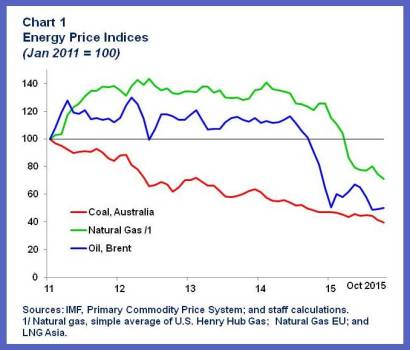


Oil prices are expected to remain lower for longer. The advent of shale oil production, made possible by hydraulic fracturing (“fracking”) and horizontal drilling technologies, has added about 4.2 million barrels per day to the crude oil market, contributing to a global supply glut. Shale oil will lead to shorter and more limited oil-price cycles. Indeed, shale requires a lower level of sunk costs than conventional oil, and the lag between first investment and production is much shorter. Furthermore, shale is still at a relatively early stage of its industry life cycle, where the scope for learning is substantial, as shown by production levels that have proven resilient thanks to phenomenal efficiency gains forced by the big drop in oil prices.

In addition, other factors are putting downward pressure on oil prices: change in the strategic behavior of the Organization of Petroleum Exporting Countries, the projected increase in Iranian exports, the scaling down of global demand (especially from emerging markets), the secular drop in petroleum consumption in the United States, and some displacement of oil by substitutes. These likely persistent forces, like the growth of shale, point to a “low for long” scenario, even after the supply legacy left by the high-price era of the 2000s has dissipated. Futures markets, which show only a modest recovery of prices to around $60 a barrel by 2019, support this view.

Natural gas and coal—also fossil fuels—have similarly seen price declines that look to be long-lived. Coal and natural gas are mainly inputs to electricity generation, whereas oil is used mostly to power transportation, yet the prices of all these energy sources are linked, including through oil-indexed contract prices. The North American shale gas boom has resulted in record low prices there. The recent discovery of the giant Zohr gas field off the Egyptian coast will eventually have repercussions on pricing in the Mediterranean region and Europe, and there is significant development potential in many other locales, notably Argentina. Coal prices also are low, owing to oversupply and the scaling down of demand, especially from China, which burns half of the world’s coal.


Renewables at risk

Technological innovations have unleashed the power of renewables such as wind, hydro, solar, and geothermal. Even Africa and the Middle East, home to economies that are heavily dependent on fossil fuel exports have enormous potential to develop renewables. For example, the United Arab Emirates has endorsed an ambitious target to draw 24 percent of its primary energy consumption from renewable sources by 2021.

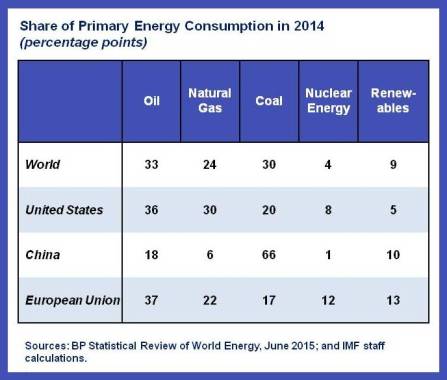
Progress in the development of renewables could be fragile, however, if fossil fuel prices remain low for long. Renewables account for only a small share of global primary energy consumption, which is still dominated by fossil fuels—30 percent each for coal and oil, 25 percent for natural gas (see Table). But renewable energy will have to displace fossil fuels to a much greater extent in the future to avoid unacceptable climate risks. Unfortunately, the current low prices for oil, gas, and coal may provide scant incentive for research to find even cheaper substitutes for those fuels. There is strong evidence that both innovation and adoption of cleaner technology are strongly encouraged by higher fossil fuel prices. The same is true for new technologies for mitigating fossil fuel emissions.
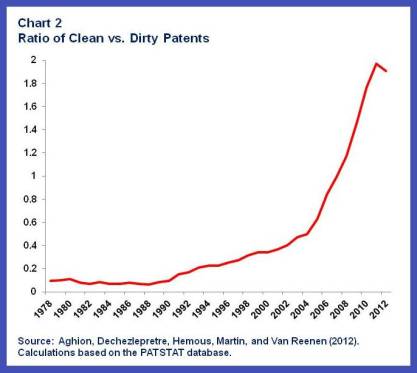


The current low fossil-fuel price environment will thus certainly delay the energy transition. That transition—from fossil fuel to clean energy sources—is not the first one. Earlier transitions were those from wood/biomass to coal in the eighteenth and nineteenth centuries, and from coal to petroleum in the nineteenth and twentieth centuries. One important lesson is that these transitions take a long time to complete. But this time we cannot wait.

We owe to electric lighting the fact that there are still whales in the sea. Unless renewables become cheap enough that substantial carbon deposits are left underground for a very long time, if not forever, the planet will likely be exposed to potentially catastrophic climate risks.

Some climate impacts may already be discernible. For example, the United Nations Children’s Fund estimates that some 11 million children in eastern and southern Africa face hunger, disease, and water shortages as a result of the strongest El Niño weather phenomenon in decades. Many scientists believe that El Niño events, caused by warming in the Pacific, are becoming more intense as a result of climate change.

Getting the price of carbon right

Nations from around the world have gathered in Paris for the United Nations Climate Change Conference, COP-21, with the goal of a universal and potentially legally binding agreement on reducing greenhouse gas emissions. We need very broad participation to address fully the global “tragedy of the commons” that results when countries fail to take into account the negative impact of their carbon emissions on the rest of the world. Moreover, free riding by non-participants, if sufficiently widespread, can undermine the political will to action of participating countries.

The nations participating at COP-21 are focusing on quantitative emissions-reduction commitments (the Intended Nationally Determined Contribution, or INDCs). Economic reasoning shows that the least expensive way for each country to implement its INDC is to put a price on carbon emissions. The reason is that when carbon is priced, those emissions reductions that are least costly to implement will happen first. The IMFcalculates that countries can generate substantial fiscal revenues—revenues that would allow lower distorting taxes and new investments in the economy—by eliminating fossil fuel subsidies and levying carbon charges that capture the domestic damages caused by emissions. A tax on upstream carbon sources is one easy way to put a price on carbon emissions, although some countries may wish to use other methods, such as emissions trading schemes.

Countries that implement their INDCs through a domestic carbon price will reach their goals at lowest cost to themselves, but without global coordination on carbon prices, the cost to the world economy of whatever aggregate emissions reduction is achieved will be unnecessarily high. In order to maximize global welfare, every country’s carbon pricing should reflect not only the purely domestic damages from emissions (for example, health effects of the particulates associated with burning coal), but also the damages to foreign countries.

Setting the right carbon price will therefore efficiently align the costs paid by carbon users with the true social opportunity cost of using carbon. By raising relative demand for clean energy sources, a carbon price would also help to align the market return to clean-energy innovation with its social return, spurring the refinement of existing technologies and the development of new ones. And it would raise the demand for mitigation technologies such as carbon capture and storage, spurring their further development. If not corrected by the appropriate carbon price, low fossil fuel prices are not accurately signaling to markets the true social profitability of clean energy. While alternative estimates of the damages from carbon emissions differ, and it is especially hard to reckon the likely costs of possible catastrophic climate events, most estimates suggest substantial negative effects.

Direct subsidies to R&D have been adopted by some governments but are a poor substitute for a carbon price: they do only part of the job, leaving in place market incentives to over-use fossil fuels and thereby add to the stock of atmospheric greenhouse gases without regard to the collateral costs.

Politically, low oil prices may provide an opportune moment to eliminate subsidies and introduce carbon prices that could gradually rise over time toward efficient levels. However, it is probably unrealistic to aim for the full optimal price in one go. Global carbon pricing will have important redistributive implications, both across and within countries, and these call for gradual implementation, complemented by mitigating and adaptive measures that shield the most vulnerable.

The hope is that the success of the Paris conference opens the door to future international agreement on carbon prices. Agreement on an international carbon-price floor would be a good starting point in that process. Failure to address comprehensively the problem of greenhouse gas emissions, however, exposes all generations, present and future, to incalculable risks.

Monday, November 16, 2015

World Energy Outlook cautiously optimistic on shift to low carbon future

The International Energy Agency issued its World Energy Outlook [worldenergyoutlook.org]. It's heavy on the connection between energy demand and climate change and aims to give some projections on short and long term developments.
Some interesting quotes from the Executive Summary [iea.org]:


There was also a tantalising hint in the 2014 data of a de-coupling in the relationship between CO2 emissions and economic activity, until now a very predictable link.

By 2040, Asia is projected to account for four out of every five tonnes of coal consumed globally, (...). However, its continued use around the world is compatible with stringent environmental policies only if it is used in the most efficient way, with advanced control technologies to reduce air pollution, and if progress is made in demonstrating that CO2 can be safely and cost-effectively captured and stored.

Despite the shift in policy intentions catalysed by COP21, more is needed to avoid the
worst effects of climate change. There are unmistakeable signs that the much-needed
global energy transition is underway, but not yet at a pace that leads to a lasting reversal 10 of the trend of rising CO2 emissions.

Thursday, October 29, 2015

New Research: Economic effects of shocks to oil supply and demand

James Hamilton [ucsd.edu] gives a nice overview on his own blog [econbrowser.com] of a new research paper [ucsd.edu, pdf] with Christiane Baumeister [sites.google.com] wherein they use a previously developed bayesian estimation method for VAR models on oil supply and demand shocks. The method allows for a generalisation and flexible adaptation of Killian (2009, AER [aeaweb.org]) and following articles.

Structural Interpretation of Vector Autoregressions with Incomplete Identification: Revisiting the Role of Oil Supply and Demand Shocks

Abstract
Traditional approaches to structural interpretation of vector autoregressions can be viewed as special cases of Bayesian inference arising from very strong prior beliefs about certain aspects of the model. These traditional methods can be generalized with a less restrictive Bayesian formulation that allows the researcher to summarize uncertainty coming not just from the data but also uncertainty about the model itself. We use this approach to revisit the role of shocks to oil supply and demand and conclude that oil price increases that result from supply shocks lead to a reduction in economic activity after a significant lag, whereas price increases that result from increases in oil consumption demand do not have a significant effect on economic activity.

Monday, October 26, 2015

Sovereign Wealth Funds in the New Era of Oil

OxCARRE associate Rabah Arezki and colleagues Adnan Mazarei, and Ananthakrishnan Prasad from the IMF, and also available on the IMFDirect blog here, write on

Sovereign Wealth Funds in the New Era of Oil

By Rabah Arezki, Adnan Mazarei, and Ananthakrishnan Prasad 

As a result of the oil price plunge, the major oil-exporting countries are facing budget deficits for the first time in years. The growth in the assets of their sovereign wealth funds, which were rising at a rapid rate until recently, is now slowing; some have started drawing on their buffers.

In the short run, this phenomenon is not cause for alarm. Most oil exporters have enough buffers to withstand a temporary drop in oil prices. But what will happen if low oil prices persist, and how will policymakers react?

We explore here the fallout from low oil prices on sovereign wealth funds in oil-exporting countries and find that that they have important domestic implications. The impact on global asset prices will depend on the extent to which the unwinding of oil exporters’ sovereign wealth funds is not compensated by portfolio adjustment in other parts of the world.

The rise of sovereign wealth funds

In the early 2000s, high oil prices brought about a massive redistribution of income to oil exporters, resulting in current account surpluses and a rapid buildup of foreign assets. Governments established new sovereign wealth funds or increased the size of existing ones to help manage the larger pool of financial assets.

The total assets of sovereign wealth funds are concentrated in a few countries. As of March 2015, it is estimated at $7.3 trillion, of which $4.2 trillion are oil and gas related. While there are large differences across sovereign wealth funds, available information on their asset allocation points to a significant share in equities and bonds. 


Oil prices and the redistribution of global income

With high oil prices throughout the 2000s, the aggregate current account balance of exporters reached about $630 billion in 2011, exceeding that of emerging Asia combined. The current account surpluses of oil exporters are vanishing in 2015, however, and it is unlikely that this decline will reverse soon. On current projections, their combined current account balances could recover to about $200 billion in 2020.

In contrast to the 2000s, the recent oil price drop has been driven mainly by supply factors  that may lead to a decoupling of the paths of asset accumulation between these two groups of sovereign wealth funds. The rate of asset accumulation by sovereign wealth funds in emerging Asia—mostly oil importers—is likely to rise but it will likely decline for the funds in oil-exporting countries. Of course, much will depend upon the strategic asset allocation choices made by the largest sovereign wealth funds in the low oil price environment.

Impact on global asset markets

The overall impact of the fall in oil prices on asset prices will depend on whether oil importers have a lower marginal propensity to save than oil exporters. The fall in oil prices tends to transfer wealth from oil exporters to high-saving emerging Asian countries—but also to many other countries, including large advanced economies, some of which have a low propensity to save. From a global perspective, this implies lower global saving and higher interest rates. 

Precisely how much the savings of the sovereign funds of oil producers decline depends, of course, on changes in their fiscal and external current account balances. Sovereign wealth funds’ market operations will also depend on how much their governments opt to borrow or draw on their fiscal buffers, including those kept with sovereign wealth funds. Saudi Arabia issued its first sovereign bonds since 2007 to local banks to finance its fiscal deficit.

In addition, oil-exporters’ sovereign wealth funds are significant holders of U.S. treasury debt and private equity. Our back-of-the-envelope calculations show that, prior to the oil price decline, countries of the Gulf Cooperation Council (GCC) alone were projected to have a combined fiscal surplus of about $100 billion in 2015 and of about $200 billion between 2015 and 2020, but are now likely to reach a combined deficit of $145 billion in 2015 and over $750 billion in 2015-20. This implies change in net assets available to sovereign wealth funds in the GCC alone of $250 billion in 2015 and $950 billion in 2015-20.

Considering the expected tightening in U.S. monetary policy—especially against the background of concerns about market liquidity, increasing risk aversion, and falling reserve holdings by some emerging markets—a substantial change in the path of asset accumulation by sovereign wealth funds will likely have a direct effect on financial markets.

A study by economists at the Federal Reserve has shown that if foreign official inflows into U.S. Treasuries were to decrease in a given month by $100 billion, five-year Treasury rates would rise by about 40 to 60 basis points in the short-run, with a long-run effect of about 20 basis points.

Domestic implications

What does all this mean for the accumulation of sovereign wealth in oil-exporting countries, at least in the medium term?

The low price environment is likely to test the relationship between governments in oil-exporting countries and their sovereign wealth funds. Absent cuts in public expenditures, governments will likely be transferring less revenue than before to these funds. At the same time, pressures to draw down on sovereign wealth funds’ assets will probably rise.
Among Middle East oil exporters, only the United Arab Emirates, Qatar, and Kuwait’s fiscal buffers will last for over 25 years on current fiscal plans and oil price projections, according to our estimates. Bahrain and Yemen will exhaust them in the next two years, while most other countries will run out of buffers in four to seven years.

Even though they’ll still be able to borrow to finance their spending, governments of these oil-exporting countries would probably do well to tighten their belts if they hope to achieve the dual objective of sharing oil wealth equitably with future generations and economic stabilization.


The Sight of inevitability II

A week late, but last weeks Economist [economist.com, some registration necessary, "Pegs under pressure" 7 oct 2015], seems to have an article inspired by a graph we posted earlier. It could be completely coincidental of course.

Tuesday, September 15, 2015

The sight of inevitability

Kazakhstan has been devaluing it's currency since last month. See the story in the FT for some comments by the Central Bank Chief Kairat Kelimbetov.

Azerbaijan has been doing the same at the beginning of the year, while Saudi Arabia has been running down its reserves. I put some of these series together in a graph (sorry for the overflow to the right).


Some analysis on recent metals price trends

The Wall Street Journal on its "Real Time Economics"-Blog highlights some forecasts on metal price trends, based on a recent IMFdirect post from Rabah Arezki and Akito Matsumoto.
Bottomline, expect prices to remain low/trending downward for the foreseeable future as the period of high prices encouraged increase supply capacity which is now combined with lower demand, which in the case of metals is for an important part driven by the expected slowing of growth in China.

The IMFdirect post highlights that for oil the downward price trend is to a larger extent driven by the supply factor and for metals the price trend is more a factor of global (Chinese) demand. 

Tuesday, June 2, 2015

Today's OxCARRE's seminar: Ryan Kellogg, Hotelling under pressure.

Today we have Ryan Kellogg [umich.edu] (University of Michigan) presenting his work with Soren T. Anderson [msu.edu]  (Michigan State University) and Stephen W. Salant [umich.edu] (University of Michigan)

Hotelling Under Pressure

Abstract:
We show that oil production from existing wells in Texas does not respond to price incentives. Drilling activity and costs, however, do respond strongly to prices. To explain these facts, we reformulate Hotelling's (1931) classic model of exhaustible resource extraction as a drilling problem: firms choose when to drill, but production from existing wells is constrained by reservoir pressure, which decays as oil is extracted. The model implies a modified Hotelling rule for drilling revenues net of costs and explains why production is typically constrained. It also rationalizes regional production peaks and observed patterns of price expectations following demand shocks.
Available here [NBER.org]

Wednesday, May 6, 2015

Why does a low oil price proof to be beneficial to GDP growth for some countries, but not for others?

This week's economists has two articles that relate a country's economic growth to the low oil price. We featured some forecasts earlier (here and here). With the first data coming in, the picture appears mixed (Quelle surprise!). 'Economists' are puzzled by the lack of economic boosts in the US, while Pakistan appears to reap the benefits. That sounds all a bit spurious to me.  However, the shared indicator seems price stability since, both are enjoying historically low inflation.

Tuesday, March 31, 2015

Hamilton on Alberta Oil sands given lower oil prices.

Over at the Econbrowser blog James Hamilton reflect on the Alberta oil sands response to declining oil prices. It appears that oil production from the Tar sands are not scaled back as quickly as other unconventional productions, such as tight gas, because the capital investment is much larger, so production will continue as long as the marginal costs are below the spot price.
Price cannot exceed long-run marginal cost in equilibrium. But at least in the case of oil sands, it could take a long, long time to reach that equilibrium.
Nevertheless, a government that had been banking on substantial revenues from taxes and royalties will be in for a downfall as well.

Saturday, March 21, 2015

at VoxEU: Plummeting oil prices, depreciating oil currencies? Not so simple

VoxEU features a post [voxeu.org] by Sascha Bützer, Maurizio Michael Habib and Livio Stracca on the effect of oil price changes on currencies, finding some unexpected results:

The large dip in oil prices reverberated across asset markets, contributing to the depreciation of the Russian rouble. This column argues that the recent fall of the rouble may be more an exception than the norm. Oil shocks have only a limited impact on global exchange rate configurations, since oil exporters tend to lean against exchange rate pressures by running down or accumulating foreign exchange reserves.

There is a paper underlying it, here [europa.eu].

Monday, January 19, 2015

'Low oil price? increase carbon price!' 4 - The Economist edition

The Economist opens with a similar argument as the previous three posts on this topic (van Ardenne, Summers, Cochrane). However, they have a broader outlook, with different policies most advised for different parts in the world.

Due to the low oil price, which is expected to stay low for a while,
[politicians] can get rid of billions of dollars of distorting subsidies, especially for dirty fuels, whilst shifting taxes towards carbon use. A cheaper, greener and more reliable energy future could be within reach.
'Bin' the subsidies to oil companies (US) and consumers around the world (India, Indonesia, Venezuela); while taxing fossil fuels where it's not done yet (US) and integrate energy/electricity markets (EU), they recommend. In general, a complete overhole of energy policies may be needed in many countries. The low price of energy today makes it less politically daunting to actually do so.

Monday, January 12, 2015

'Low oil price? increase carbon price!' 3 - John Cochrane edition

John Cochrane responded, already a week ago, to Larry Summers op-ed on a carbon tax. He notes some comments from others and brings forth a few of his own thoughts. On of main ones is that a tax on carbon is not the only way to increase the price (so my blog series title remains valid, phew), how about a cap-and-trade, he asks.

The post pulls the idea very much into the American context. In particular, talking about a new tax breaks open the pandora box on income distribution and loopholes. The main idea of course was much generally applicable. So what is happening in other places. For instance, is there talk on further reducing the number of permits available in the European Emissions Trading Mechanism?

As a matter of fact. There is already discussion ongoing at European levels (here [ft.com], here  and here [bloomberg.com]) to reduce the number of permits in the market to increase the price, currently around €6.70 [theice.com]. In summary, these discussions were already ongoing for a while because since the great recession there is a glut of permits, in the already overwhelmed market from time that governments gave away too many credits. Some of these permits will be taken from the market, potentially to be returned in the future. The fight is going to be whether they will be. In the short term, the price of permits is expected to rise by 50-60% by June this year. I found no mention that the current oil price place a role in these decisions. As Cochrane mentions in his post, referring to the oil price of 6 months ago, as Summers did, for new policy that may take at least another 6 months to form, but likely years, is not very convincing.

Outside Europe? South Korea will start its exchange on today (12 January, here [rsc.org] and see also the second Bloomberg article above). 

Monday, January 5, 2015

'Low oil price? increase carbon price!' 2 - Lawrence Summers edition

A few weeks ago, Maria van der Hoeven, executive-director of the International Energy Agency advocated a carbon tax introduction now that oil prices are low. Lawrence Summers advocates [FT.com] the same today for the US.